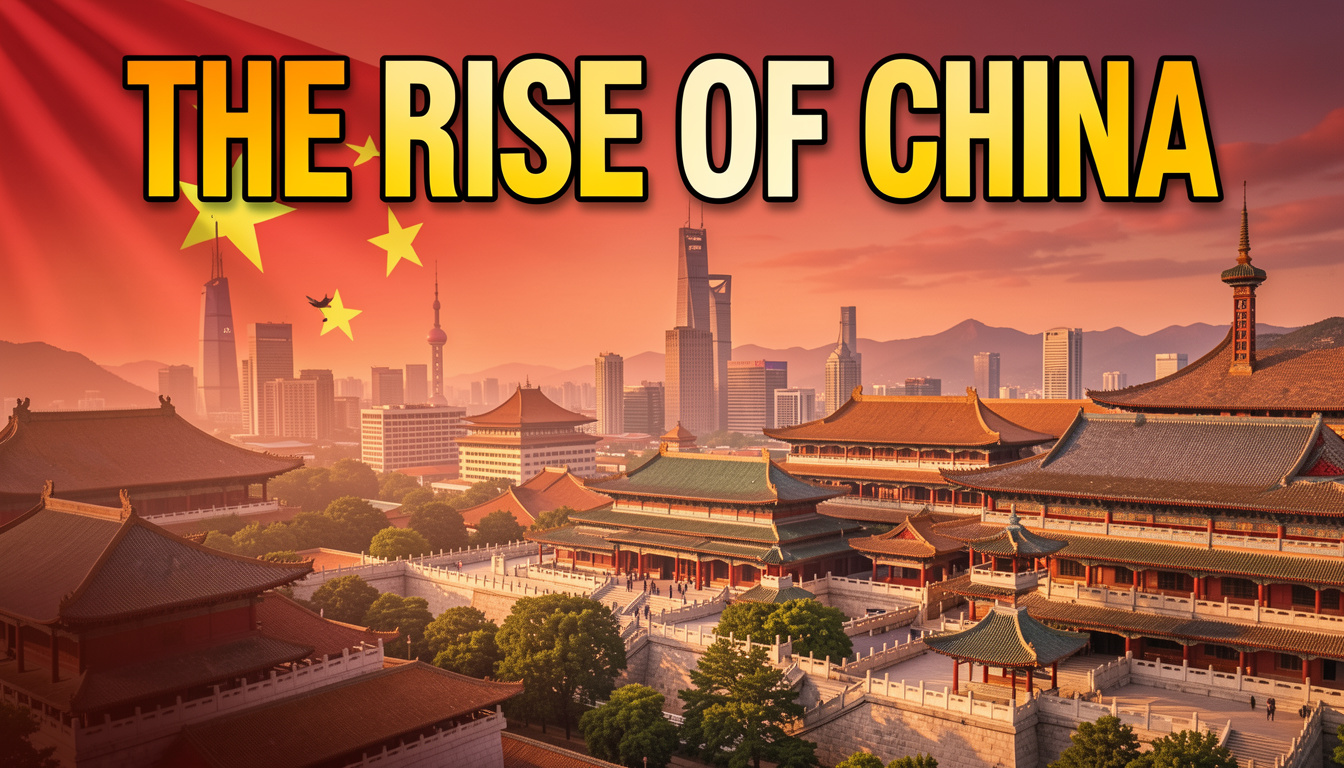
In the early 21st century, the global balance of power has been reshaping — not by accident, but by decades of economic integration, technological progress, and geopolitical adaptation. At the heart of this transformation stands China, whose rise from a largely agrarian economy to a global powerhouse has challenged the long-held dominance of the United States. What was once a world clearly led by Washington is now a far more complex, interconnected arena where Beijing’s influence is growing, and Western countries are recalibrating longstanding policies.
Trump’s “Board of Peace”: A New World Order or a U.S. Power Play?
The U.S. Path to Global Prominence
To understand China’s ascent, it’s essential to revisit the trajectory of U.S. global influence. After World War II, the United States emerged economically unscathed amid widespread destruction in Europe and Asia. It anchored the postwar international system by:
- Establishing the Bretton Woods regime — including the International Monetary Fund and the World Bank — to stabilize global finance and trade.
- Cementing the U.S. dollar as the world’s primary reserve currency due to its dominance in trade, capital markets, and the legacy of vast gold and economic reserves.
- Projecting unparalleled military power through NATO and a global network of alliances.
- Spearheading international institutions (e.g., the United Nations) that reflected U.S. leadership and the liberal economic order.
For much of the late 20th century, this arrangement helped the United States shape global finance, diplomacy, and trade rules. Yet even then, the seeds of change were being sown.
China’s Transformation
China’s path was different — and rapid.
• Economic Integration: After opening its economy in the late 1970s, Beijing embraced export-led growth and foreign investment. By the 2000s, China had become a center of global manufacturing and supply chains.
• Trade Dominance: In the first 11 months of 2024, China registered a trade surplus of over $1 trillion, dwarfing early 21st-century figures and reflecting deep integration into global commerce.
• Global Reach: By 2023, roughly 70% of the world’s economies traded more with China than with the United States — a dramatic reversal of the situation in 2001, when the U.S. was dominant in two-way trade for most countries.
• Industrial Base: China’s manufacturing prowess and export capacity gave it influence across sectors from electronics to renewable technologies, often outpacing U.S. industries in scale and output.
This economic ascent has translated into geopolitical influence. Beijing has pursued investment and infrastructure projects worldwide, most notably through initiatives like the Belt and Road Initiative, while expanding its diplomatic presence in Africa, Latin America, and Southeast Asia.
Patterns of Power: Similarities and Differences
Two emerging patterns help explain both U.S. and Chinese rise:
1. Integration into Global Trade
Both powers used trade as a foundation — the United States through dominance in global finance and consumer markets, China through manufacturing and exports. Trade networks created interdependence that translated to political influence.
2. Internal Policy Continuity
Long periods of consistent development and state direction — whether in post-war U.S. industrial policy or China’s managed economic growth — enabled sustained expansion. In China, continuity of governance and prioritization of infrastructure and technology has kept momentum moving.
Yet key differences also matter: the United States historically paired economic ascendancy with alliance systems and defense commitments; China has emphasized economic ties first, with strategic partnerships and infrastructure diplomacy following.
Western Hesitation Toward China — and Why It’s Changing
Many Western countries were cautious about China for decades due to:
- Human rights concerns (especially in Xinjiang and Tibet).
- Intellectual property issues and market access barriers.
- Security worries over technology and military expansion.
However, this caution has been giving way to pragmatic engagement, influenced in part by shifting U.S. policies. Under President Donald Trump’s “America First” stance, aggressive tariff strategies and unpredictable foreign policy have strained traditional alliances and pushed some Western nations toward China as a trade and diplomatic counterbalance.
Recent high-profile visits illustrate this trend:
- Canada’s Prime Minister Mark Carney traveled to Beijing in January 2026 to forge a new strategic partnership, including agreements on clean energy, agriculture, and investment, as Ottawa seeks to diversify its trade beyond heavy reliance on the United States.
- The United Kingdom’s Prime Minister Keir Starmer also visited China days later, announcing a renewed framework of cooperation in trade, visas, and investment — citing the need for economic stability and predictability amid tensions with the U.S. government.
These shifts reflect economic realities: China remains one of the world’s largest markets and a central engine of global demand, while U.S. tariff threats and policy volatility have made Western partners examine alternatives.
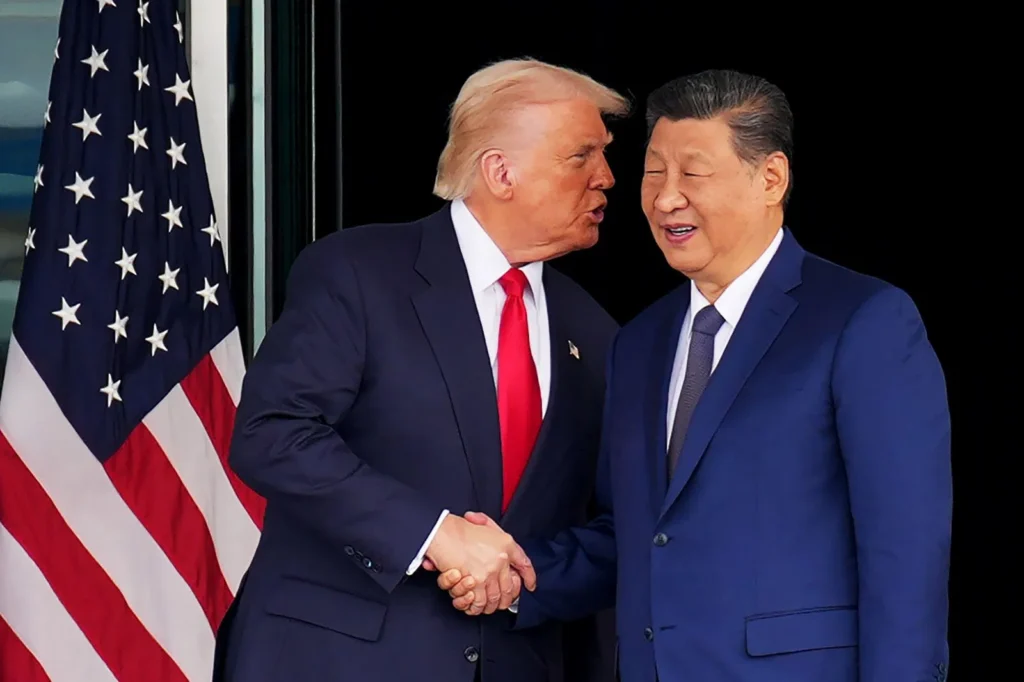
BUSAN, SOUTH KOREA – OCTOBER 30: U.S. President Donald Trump and Chinese President Xi Jinping shake hands as they depart following a bilateral meeting at Gimhae Air Base on October 30, 2025 in Busan, South Korea. Trump is meeting Xi for the first time since taking office for his second term, following months of growing tension between both countries. (Photo by Andrew Harnik/Getty Images)
Is Trump Enabling China’s Rise?
Trump’s aggressive trade posture — including tariff battles with China and allies like Canada — has paradoxically contributed to Beijing’s diplomatic gains. According to global surveys, Trump’s policies are widely perceived to have benefited China’s influence more than America’s in certain areas, particularly in technology and international partnerships.
Instead of leading a unified Western front, the United States’ unilateral actions have driven some countries to pursue independent strategies with Beijing. Analysts describe this trend as a movement toward a multipolar world, where regional and mid-sized powers build diversified alliances and no single state dictates global norms.
Yet Beijing’s gains are not automatic wins: Western skepticism remains regarding human rights, cybersecurity, and strategic intent. Engagement with China often comes with careful hedging — balancing economic collaboration with wariness of Beijing’s long-term goals.
Conclusion: A Redefined World Order
The rise of China and the recalibration of Western alliances do not signal a simple “end of American dominance.” Rather, they reflect a transition from a U.S.-centric world to a more multipolar landscape, shaped by economic interdependence, strategic competition, and recalibrated alliances.
Patterns from the past — trade integration, domestic economic continuity, and the leveraging of financial influence — are visible in both the American ascent of the 20th century and China’s dramatic rise today. But the ways these patterns interact with political choices and international institutions have changed, particularly as countries respond to shifting policies and global uncertainties.
In this evolving environment, global leadership may no longer reside in a single nation. Instead, power will be negotiated among great powers, emerging economies, and networks of states whose interests intersect and diverge in complex ways.