The 2025 National Security Strategy Isn’t Just a Policy Document. It’s the Opening Chapter of America’s Next Great Power Play.
When the Trump administration released the 2025 National Security Strategy (NSS), it was not the quiet bureaucratic exercise Washington has come to expect.
It landed more like a shockwave—a statement of intent, a philosophical manifesto, and a blunt rejection of the worldview that shaped U.S. policy for nearly three decades.
There is no subtlety in the document’s central message:
America has wasted too much time defending the global order. Now, it must defend itself.
Rather than project liberal values abroad, the strategy insists the United States must rebuild strength at home, renegotiate the terms of its alliances, and focus on “regional threats” rather than ideological crusades. It is a worldview as clear as it is radical: great-power competition begins at the water’s edge—and sometimes even within the hemisphere.
Trump’s Immigration Freeze: Security Shield or the Return of a Global Color Line?
A Return to Hard Borders and Hard Power
The NSS pivots away from nation-building and democracy-promotion and toward what it calls “sovereignty-first diplomacy.” This marks a dramatic departure from the post-Cold War formula in which the United States justified interventions abroad by invoking democracy or human rights.
In Trump’s 2025 vision, power—not principles—is the currency of global politics.
The document lists America’s top priorities as:
- Securing the homeland
- Disrupting foreign espionage
- Countering fentanyl trafficking
- Ending illegal immigration
- Rebalancing trade
- Deterring China in the Indo-Pacific
- Pressuring Iran and Russia through “selective engagement”
If previous strategies framed America as the world’s architect, this one positions the U.S. as a fortress—one that engages only when the benefits are concrete and the risks limited.
Europe: Partner, Burden, or Strategic Distraction?
Where earlier National Security Strategies described Europe as America’s foundational ally, the 2025 NSS treats the continent with cool pragmatism—sometimes bordering on impatience.
The document scolds NATO members for “decades of underspending,” attacks “entrenched bureaucracies in Brussels,” and suggests that America’s future lies less with global coalitions and more with bilateral partnerships that reward loyalty and penalize hesitation.
Importantly, the strategy does not say the U.S. will manipulate European politics or “cultivate far-right parties.”
That language is not in the document.
But the NSS does say this:
The United States will strengthen relations with European nations that are “fully committed” to shared security goals.
The implication is unmistakable:
Washington will no longer treat all European states as equal partners.
Those who increase defense spending, harden borders, counter China, and align with U.S. positions will get preferential treatment. Those who don’t—Germany is mentioned indirectly through references to “industrial dependence” and “strategic hesitation”—may find themselves sidelined.
This is not covert meddling.
It is strategic triage.
The Ideological Core: Civilizational Confidence
While the NSS avoids the incendiary language of campaign rallies, it does embrace a civilizational argument:
- Western nations face declining birthrates
- Democratic institutions are strained
- Political polarization has made consensus governance difficult
- Societies must strengthen “cultural confidence” and cohesion
These themes echo the administration’s public messaging, but they stay within formal policy boundaries. There is no endorsement of specific European parties or leaders. Instead, the document argues that the U.S. has an interest in a strong, stable Europe—defined by sovereignty, secure borders, reduced dependence on adversaries, and revived economic competitiveness.
In Trump’s framing, this is less culture war and more strategic realism:
A fragmented Europe is a liability.
A confident Europe is a partner.
A complacent Europe is a cost.
A Hemisphere-First Strategy
One of the most striking shifts in the document is its insistence that the Western Hemisphere—not Europe or the Middle East—is now America’s strategic center of gravity.
This reflects concerns about:
- Chinese investment in Latin America
- Drug cartels functioning as transnational paramilitary groups
- Migration pressures on the southern border
- Political instability in key countries like Haiti and Venezuela
In the eyes of the administration, the greatest threats to U.S. stability are geographically close, not ideologically distant.
This hemispheric reorientation is perhaps the most significant evolutionary step in U.S. foreign policy in half a century. It implies a world where America no longer sees itself as the guardian of global order—but rather the architect of a regional one.
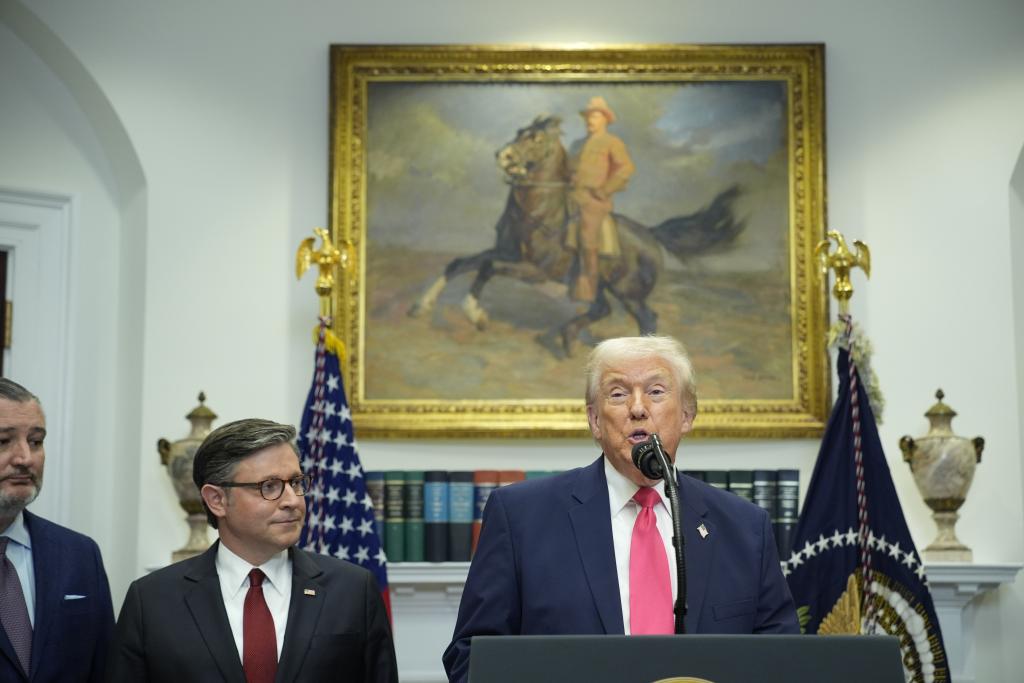
Trump has frozen immigration applications from 19 countries over possible terror threats. Ron Sachs/CNP / SplashNews.com
Selective Engagement: Neither Isolationism nor Internationalism
Critics call the NSS isolationist.
Supporters say it’s nationalist.
But the document itself describes the approach differently:
“Strategic restraint combined with decisive action when core interests are threatened.”
This is the philosophy known as selective engagement:
- Avoid expensive global commitments
- Maintain overwhelming military superiority
- Intervene only where American prosperity and security are directly at stake
Under this doctrine, the U.S. doesn’t retreat from the world; it reorganizes its priorities.
China remains the central long-term challenge.
Russia remains the acute short-term disruptor.
Iran, North Korea, terrorism, and cyberwarfare are persistent dangers.
But America’s role shifts from global steward to strategic competitor.
The Bottom Line: A New Era of Realism
The 2025 NSS doesn’t hide its worldview:
- The liberal international order is “no longer fit for purpose.”
- The U.S. will not underwrite Europe’s security unconditionally.
- Sovereignty takes precedence over multilateralism.
- Power—not norms—defines global behavior.
- Domestic strength is the precondition for international leadership.
Whether this vision strengthens America or weakens the world is a debate that will rage for years. But one thing is certain:
This is not a shadow war. It is an openly declared restructuring of global power—authored in Washington, but destined to be felt everywhere else.
If the 2025 National Security Strategy is the blueprint, the next decade will be the construction site.
And the world is watching what kind of superpower America decides to build.