In January 2026, on the sidelines of the World Economic Forum in Davos, Switzerland, U.S. President Donald Trump formally launched a controversial new international organization called the Board of Peace — an ambitious initiative initially rooted in the ceasefire and reconstruction plan for the war-torn Gaza Strip but rapidly evolving into a broader diplomatic framework with global implications.
Why Trump’s Greenland Obsession Sparks Global Fear — And What the Davos Turnaround Really Means
Origins and Purpose
The Board of Peace (BoP) was first proposed in September 2025 as part of Trump’s 20-point peace plan aimed at ending the Israel-Hamas war and rebuilding Gaza. It was designed to help oversee stability, governance, demilitarization and reconstruction in areas affected by conflict, with its first focus being Gaza’s recovery.
A United Nations Security Council resolution (No. 2803) endorsed the board’s creation in November 2025 to aid implementation of the ceasefire plan, granting it a mandate tied to Gaza’s post-war stabilization. Yet the board’s subsequent charter, signed in Davos on January 22 2026, makes no explicit mention of Gaza alone — suggesting a potential expansion of its scope.
Unlike United Nations bodies, the BoP is structured as a U.S.-led, voluntary organization — a model that is already drawing comparisons to rival international governance frameworks.
A Prestigious But Pricey Club
One of the most debated aspects of the Board of Peace is its membership model. According to reporting, countries that want a permanent seat must contribute at least $1 billion to the organization. This “pay-to-play” mechanism has raised eyebrows among diplomats and analysts alike, prompting some to describe the BoP as more akin to a global club for wealthy nations than a traditional peace institution. Critics argue that requiring such a large financial commitment risks privileging powerful or wealthy states and sidelining smaller or middle powers.
In contrast, the UN system — including the Security Council’s permanent and rotating members — does not impose similar commercial membership fees, relying instead on assessed contributions distributed more evenly among member states.
Who Has Joined — and Who Has Stayed Out?
As of early 2026, at least 19 invited states have signed the board’s charter, including Argentina, Belarus, Hungary, Morocco, Azerbaijan, Bahrain, Kazakhstan, Kosovo, Uzbekistan and a handful of others.
Notably absent from the membership list are key Western powers, several European Union members, and middle powers:
- Most of the EU — including France, Germany, Italy and Spain — have opted not to join or have expressed reservations, fearful that the board could undercut the United Nations or create parallel global governance structures that weaken traditional multilateral coordination.
- Canada was also excluded from key discussions and invitations, a move interpreted by some analysts as a strategic sidelining of middle powers that traditionally champion multilateralism.
Sources report that European leaders have been wary of endorsing an institution where decision-making power appears concentrated in Washington and where membership may hinge on financial leverage rather than diplomatic consensus.
Interpretations: New World Order or U.S. Dominance?
The Board of Peace has ignited intense debate among international relations experts, diplomats and civil society:
Supporters argue that the board offers a more decisive, results-oriented approach to conflict resolution and reconstruction — especially in situations where traditional UN mechanisms have stalled or become bogged down by competing interests or veto politics.
Critics fear it represents a form of U.S. geopolitical expansion, positioning Washington at the center of a new global architecture that could gradually eclipse existing institutions like the United Nations. A leading editorial in Le Monde described the board as borne of the same hubris that seeks to overshadow the UN with an entity centered on Trump’s authority and vision.
The board’s leadership structure, which names Trump as inaugural chairman without a fixed term, has been especially controversial. Analysts note that while other international organizations have rotating or elected leadership, the BoP’s top job effectively remains tied to a single national leader unless future members agree otherwise.
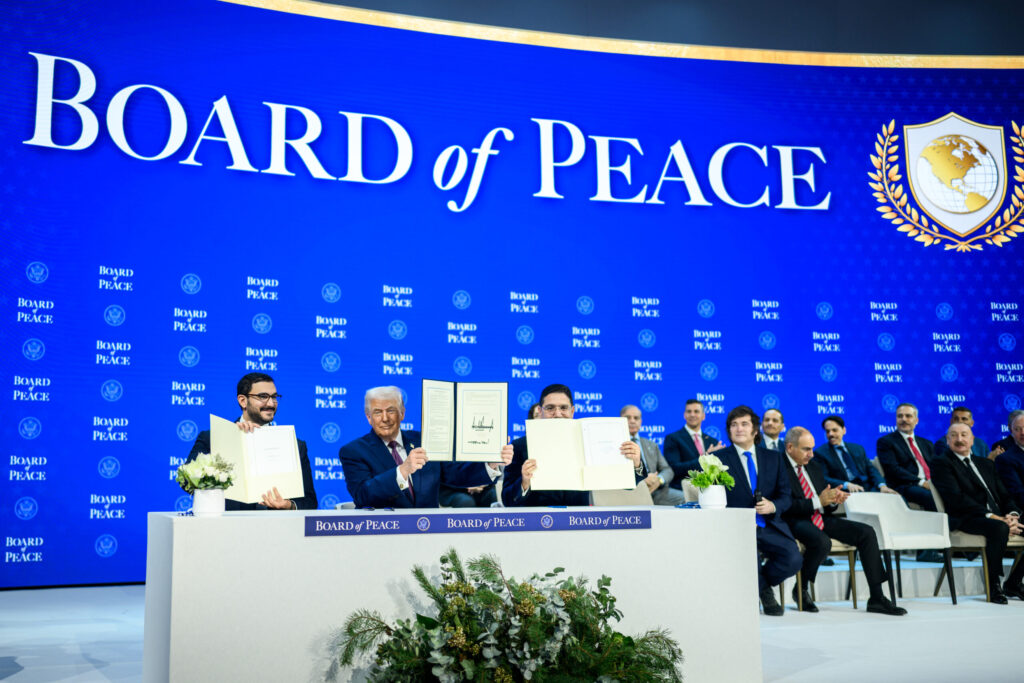
President Donald Trump, center, holds up a signed Board of Peace charter during the Annual Meeting of the World Economic Forum in Davos, Switzerland, Thursday, Jan. 22, 2026. (AP Photo/Evan Vucci)
EU Influence and the Decline of Traditional Multilateralism?
The decision by many key EU states to distance themselves from the Board of Peace has reignited discussions about Europe’s role in shaping the global order:
- France and Germany, traditional pillars of EU foreign policy, have expressed skepticism about the board’s structure and authority, even while supporting peace efforts in Gaza and elsewhere. They argue that any new mechanism must respect existing international law and avoid duplicating or undermining the United Nations.
- The United Kingdom and EU Commission have also emphasized the importance of working through established multilateral forums, highlighting concerns that the BoP could siphon legitimacy and resources away from the UN system.
Critics warn that Europe’s reluctance could reflect deeper shifts in geopolitical power — where dominant initiatives are increasingly emerging outside the traditional EU-UN axis, particularly on matters where U.S. strategic interests are strong.
Middle Powers and Canada’s Exclusion
Canada’s absence from the Board of Peace helps illustrate another geopolitical dynamic: the diminishing influence of middle powers in new governance projects spearheaded by major powers.
Historically, countries like Canada have played pivotal roles in peacekeeping, humanitarian diplomacy and multilateral governance. Their exclusion from the BoP’s core leadership raises questions about whether global architecture is becoming polarized between superpower-led initiatives and secondary groupings that lack broad legitimacy.
Some commentators see this as part of a larger pattern in international politics where alliances increasingly reflect strategic alignment or political signaling rather than inclusive diplomacy — particularly in arenas like post-conflict reconstruction, economic development frameworks, and security cooperation.
How the Board Differs From the United Nations
The Board of Peace diverges from the United Nations in several clear ways:
- Funding model: Permanent seats require a $1 billion contribution, a stark contrast to the UN’s assessed contribution system, which scales with national income and does not grant special authority based on funding alone.
- Leadership concentration: Trump’s role as inaugural — potentially long-term — chairman gives the U.S. significant sway over agenda and direction.
- Membership dynamics: Participation is by invitation and direct acceptance by Trump, not universal accession as with the UN.
- Mandate flexibility: While initially tied to Gaza, its charter does not specifically limit its work to one region — enabling a broader peace and reconstruction role that could extend globally.
These structural differences explain why some global actors are excited about the board’s potential to innovate on peace processes, while others see it as a parallel institution that could challenge long-standing norms of international diplomacy.
What Comes Next?
The future of the Board of Peace remains uncertain:
- Will it expand beyond Gaza to address other conflicts? Analyst discussions suggest possible broadening of mandate.
- Can it gain legitimacy with Western European powers, traditional peacekeeping states, and civil society partners?
- Or will it deepen divisions between U.S.-led initiatives and multilateral institutions like the UN?
What is clear is that the Board of Peace is far from a quiet bureaucratic experiment. It has thrust a new model of international governance into the global spotlight — one that could reshape diplomatic alliances, development priorities and the very idea of how peace is negotiated in the 21st century.