On January 3, 2026, U.S. special forces executed one of the most dramatic and controversial operations in recent history: the capture of Venezuelan President Nicolás Maduro and his wife, Cilia Flores, during a military raid in Caracas. The pair were flown to the United States to face federal charges, igniting intense global debate over legality, sovereignty, and the future of international norms.
Dubbed Operation Absolute Resolve, the mission marked a rare instance of a sitting head of state being seized abroad by U.S. forces. The United States bombarded multiple sites in Venezuela, deployed elite units including Delta Force, and transported Maduro and Flores to New York, where they appeared in federal court. Both pleaded not guilty to a superseding indictment that includes narco-terrorism and drug trafficking charges first brought in 2020.
Trump Signals Unconditional Backing for Israel as Iran Nuclear Fears Resurface
Origins of the Conflict
Tensions between Maduro and the United States are decades in the making. Caracas has faced U.S. sanctions, indictments, and escalating diplomatic hostility since the Trump administration accused Maduro of presiding over a regime entwined with drug cartels and transnational crime. In 2020, a U.S. indictment charged Maduro with narco-terrorism conspiracy and cocaine importation, and a multi-million-dollar reward was offered for his arrest.
Critics viewed Maduro’s 2024 reelection as neither free nor fair, deepening U.S. isolation of his government. Trump’s rhetoric increasingly framed the Venezuelan leader not just as an authoritarian adversary but as a criminal whose alleged actions constituted direct harm to the United States—a framing that underpinned the legal justification for the operation.
Legality in the Crosshairs
At the heart of the international controversy lies a simple but profound question: Was the operation legal?
Under the United Nations Charter, the use of force in another nation’s territory is prohibited absent UN Security Council authorization, clear self-defense, or consent from the host state. Maduro’s capture occurred without any of these, leading many legal experts and world leaders to label the action a violation of international law. UN Secretary-General António Guterres warned that it sets a “dangerous precedent.”
Maduro’s defense in U.S. court has already raised head-of-state immunity arguments, asserting that as a sovereign leader he should not be subject to foreign prosecution. This defense echoes historical legal debates, but it confronts a stark reality: Modern international law grants sitting heads of state immunity under most circumstances, even for serious alleged crimes.
Supporters of the U.S. action draw comparisons to the 1989 U.S. capture of Panamanian leader Manuel Noriega, another controversial case in which a leader was removed and tried abroad. But Noriega’s status was already delegitimized, and the Panama operation was launched with broader justification tied to protecting the Panama Canal and drug enforcement; Maduro’s seizure unfolded without similar consensus or legal backing.
Domestic and International Fallout
Within Venezuela, reactions have been profound and mixed. Vice President Delcy Rodríguez was sworn in as interim president, but support for Maduro remains strong among many citizens. In Caracas, wary residents reported lingering shock and disruption as markets and daily life remained unsettled after the raid.
The United States has faced bipartisan debate. Some lawmakers labeled the operation “decisive and necessary,” while others criticized the lack of congressional approval and the absence of a clear legal mandate. Internationally, powerful states including Russia, China, and Cuba condemned the action as unlawful aggression, while Argentina’s government praised Venezuela’s liberation from what it called an illegitimate regime. European Union officials expressed concern and urged strong adherence to international law.
Global institutions like the UN Security Council reviewed the matter amid heated debate about sovereignty and the limits of unilateral military action. Many diplomats stressed that even leaders accused of egregious crimes must be held accountable through legal and diplomatic channels, not extrajudicial force.
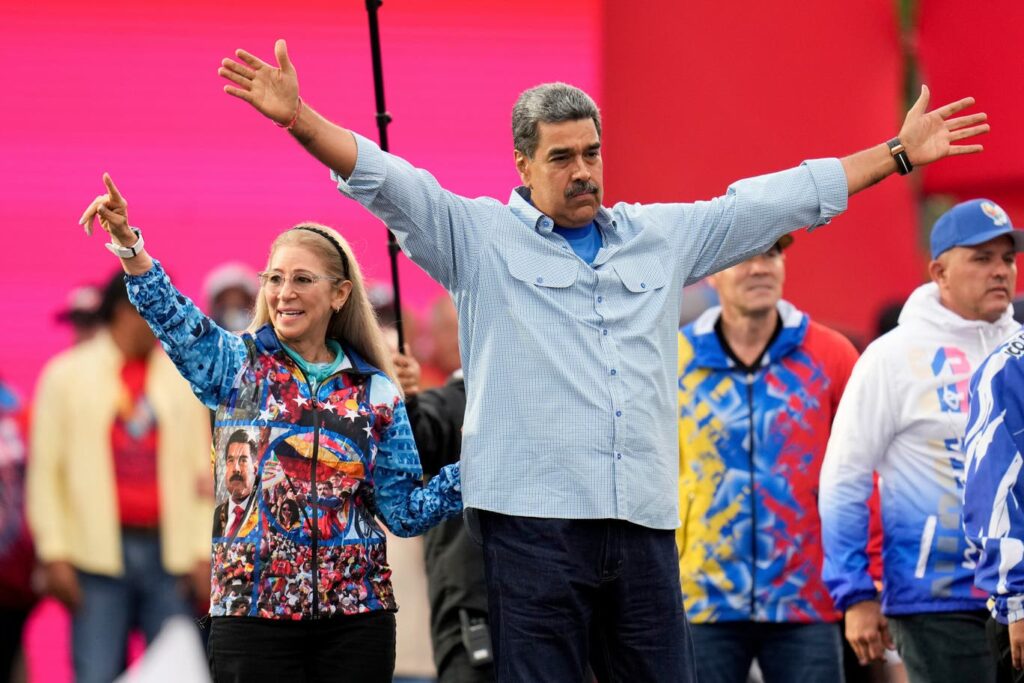
Nicolás Maduro and his wife Cilia Flores (R) were seized in a US raid at the weekend (AP)
What Comes Next
With Maduro in U.S. custody, the legal process is only beginning. His arraignment in Manhattan opened a high-stakes case that could take months or years. Legal experts expect complex pretrial motions as defenses push head-of-state immunity and challenges to the very legality of the capture.
In Caracas, political uncertainty lingers. Opposition figures like María Corina Machado welcomed Maduro’s removal but distanced themselves from American intervention, underscoring a nuanced domestic response that rejects both the old regime and foreign domination.
Regionally, neighboring countries are bracing for potential spillover. Latin American leaders issue starkly divergent reactions: some warn of imperial overreach, others cautiously support efforts to end authoritarian governance. Meanwhile, the specter of Venezuelan oil and its geopolitical importance looms large, potentially influencing energy markets and diplomatic alignments for years to come.
A Turning Point for the International Order
Maduro’s capture represents more than regime change; it is a test of the rules-based international system. If powerful states can unilaterally detain sovereign leaders abroad without clear legal grounding, the norms designed to protect smaller nations and prevent abuses of power may be forever weakened. Critics warn that this could embolden other nations to pursue similar downfalls of leaders they oppose, eroding the legal foundations that underpin diplomacy and global stability.
Whether this becomes a model for accountability or a precedent for the abuse of power will depend on how international law, U.S. courts, and global institutions respond in the months and years ahead.