For more than two decades, China has run one of the largest and most persistent trade surpluses in modern economic history. What began as an export-driven growth strategy in the early 2000s has evolved into a global manufacturing dominance that now shapes — and in some cases distorts — industrial production across continents. From North America to Europe, from Southeast Asia to Africa, China’s trade surplus has become both a symbol of its economic success and a source of mounting anxiety for governments trying to protect their own manufacturing sectors.
At its core, a trade surplus means a country exports more goods than it imports. In China’s case, that surplus is not marginal — it is structural. Massive industrial capacity, state-backed financing, currency management policies, and tightly integrated supply chains have enabled Chinese firms to produce goods at prices many foreign competitors struggle to match. The result is a flood of Chinese exports into global markets — from steel and solar panels to electric vehicles, batteries, consumer electronics, and heavy machinery.
Uneven Ascendance: China’s Rise and the Shifting World Order
The Manufacturing Imbalance
China’s industrial rise did not happen by accident. Beginning in the late 20th century, Beijing pursued an export-led development model. Special economic zones attracted foreign investment, infrastructure spending connected factories to ports, and low labor costs gave multinational corporations a reason to relocate production. Over time, however, China moved beyond low-cost assembly. It climbed the value chain into advanced manufacturing, high-speed rail, semiconductors, renewable energy equipment, and electric vehicles.
Today, Chinese firms operate at enormous scale. That scale creates a feedback loop: higher production lowers per-unit costs, which undercuts foreign competitors, which leads to plant closures abroad, which further increases China’s global market share.
Countries that once relied on domestic steel, textile, electronics, or machinery industries increasingly find themselves dependent on imports from China. Even when governments impose tariffs or anti-dumping measures, Chinese supply chains often reroute through third countries, preserving export flows.
Overcapacity and Global Price Suppression
A major concern among economists is industrial overcapacity. When domestic demand in China slows — as it has in recent years due to property market stress and demographic challenges — manufacturers often turn outward, exporting excess production. This pushes global prices downward.
While lower prices benefit consumers in the short term, they strain manufacturers elsewhere. Steel producers in Europe, auto parts manufacturers in North America, and solar panel companies in Asia have all warned that they cannot compete with heavily subsidized Chinese competitors.
The European Union has launched investigations into Chinese electric vehicle subsidies. The United States has expanded tariffs on certain Chinese imports. Developing countries have also begun introducing safeguard measures. Yet China’s scale makes defensive policies difficult to sustain without raising costs for domestic consumers.
Supply Chain Dependency
Another consequence of China’s surplus is supply chain dependency. Many industries worldwide rely on Chinese intermediate goods — parts, raw materials, and components that are essential for final assembly elsewhere. Rare earth processing, battery materials, and certain pharmaceutical ingredients are heavily concentrated in China.
This dependency creates strategic vulnerability. During periods of geopolitical tension, trade disputes, or global crises — such as the COVID-19 pandemic — supply disruptions expose how deeply integrated global manufacturing has become with Chinese production.
Some governments are now pursuing “reshoring” or “friend-shoring” strategies, encouraging companies to move production closer to home or to allied nations. However, rebuilding manufacturing ecosystems takes years and requires significant investment.
The Currency and Policy Debate
Critics argue that China’s surplus is not purely the result of efficiency but also of policy choices. These include industrial subsidies, state-directed lending, export incentives, and historically, currency management practices that kept exports competitive.
Chinese officials counter that their success reflects productivity, infrastructure investment, and skilled labor — not unfair manipulation. They also note that Western consumers and corporations benefited enormously from decades of lower-priced goods.
The debate increasingly centers on whether global trade rules — largely designed in the late 20th century — are equipped to manage an economic power of China’s scale and state-driven model.
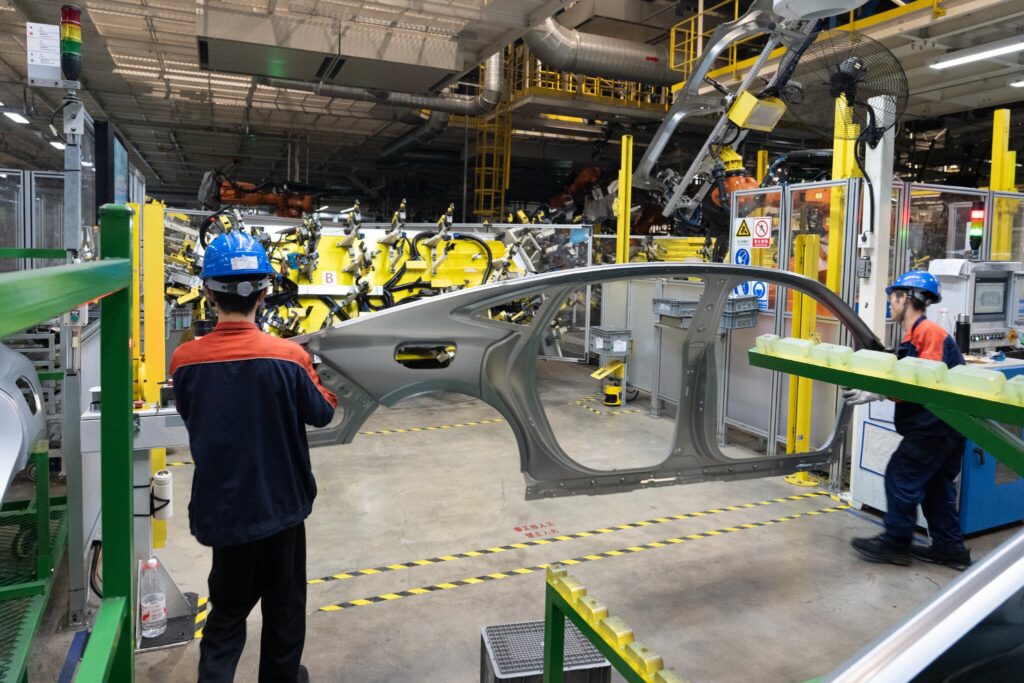
The production line at a car factory in Hangzhou, China, in October. Exports to the United States fell, but rose to much of the rest of the world.Credit…Chang W. Lee/The New York Times
The Impact on Developing Economies
The effect of China’s surplus is not limited to advanced economies. Many developing nations have seen domestic manufacturing struggle under pressure from low-cost Chinese imports. Textile factories in parts of Africa, small machinery producers in Latin America, and electronics assemblers in Southeast Asia face intense competition.
At the same time, China has become a major investor and infrastructure partner in many of these regions through initiatives such as the Belt and Road Initiative. This creates a dual dynamic: economic opportunity through investment, but industrial displacement through imports.
Is the Global System Adjusting?
The global response is fragmented. The United States has increased tariffs and emphasized industrial policy through domestic manufacturing incentives. The European Union is tightening trade defense instruments. Japan and South Korea are investing heavily in strategic sectors. Emerging markets are recalibrating trade ties.
Yet global trade remains deeply interconnected. Many multinational companies still rely on Chinese production for profitability. Consumers worldwide benefit from affordable goods. Breaking away from China’s manufacturing dominance would come at a cost — potentially higher prices and slower growth.
The Bigger Question
The concern that China’s trade surplus “strangles” global manufacturing is less about one country’s success and more about structural imbalance. When one nation dominates production across multiple sectors simultaneously, others struggle to maintain industrial diversity.
The long-term issue may not be trade itself but resilience. Can the global system sustain heavy dependence on a single manufacturing powerhouse? Or will a new phase of industrial diversification emerge?
China’s surplus represents both strength and tension — a testament to industrial transformation and a challenge to the balance of global production. Whether the world adapts through cooperation, protectionism, or strategic competition will shape the next era of manufacturing.