In early 2026, U.S. President Donald Trump once again placed Greenland at the center of global geopolitical debate — not as a distant Arctic territory, but as a flash point in America’s strategy, alliances, and international norms. Trump’s rhetoric has oscillated between ominous threat and diplomatic accommodation, raising fears among European leaders and NATO allies that the United States might not hesitate to use its power for territorial advantage. But after months of controversy, Trump used his World Economic Forum speech in Davos to rule out military force — a shift with important implications.
Iran in Turmoil: Protests, Power Plays, and America’s Strategic Opportunity
Trump’s Early Threats: Force, Strategy, and Fear
Before Davos, Trump’s comments on Greenland were strikingly aggressive. In January 2026, he asserted that the United States might have to use “excessive strength and force” if needed to secure Greenland — even claiming the U.S. would be “unstoppable” in such an effort.
Although those words were framed as bargaining posture, many NATO officials and European leaders heard them as serious warnings. The idea that a major power might seize a territory from a fellow alliance member unsettled long-standing assumptions about sovereign borders and alliance trust — especially at a moment when NATO unity is being tested on multiple fronts.
That fear was amplified by another dramatic international event: the capture of Venezuela’s president, Nicolás Maduro, by U.S. forces earlier in January 2026. Trump’s decision to remove a sitting head of state without public allied mandate or broad international legal backing sent shock waves through capitals like Copenhagen, London, and Berlin. If the United States could carry out such a decisive act in South America, NATO leaders wondered, what stops it from using similar force in the Arctic if a crisis arises? While Maduro’s capture was justified by U.S. authorities under domestic criminal charges, the fact that it happened at all contributed to perceptions of unpredictability in Washington’s use of power.
Why Greenland Matters to the U.S.
To understand Trump’s focus, it helps to see why Greenland is more than “a piece of ice.” The island’s strategic value is rooted in three key areas:
1. Arctic Defense and Geopolitics — Greenland sits at the gateway to the Arctic and the North Atlantic. As ice melts and new routes open, control over this region gives any military power leverage in surveillance, early missile warning systems, and naval operations.
2. Great-Power Competition — Russia and China have both signaled increased interest in the Arctic. Russia has expanded military assets, while China calls itself a “near-Arctic state” and pursues economic footholds in the region. Greenland’s location makes it a pivotal platform in this broader rivalry.
3. Resources and Infrastructure — Beyond defense, Greenland is rich in rare earth minerals and other resources critical for advanced technologies and green energy. While Trump emphasizes security, these economic factors enhance its overall geopolitical importance.
Davos 2026: From Force to Framework
At the World Economic Forum in Davos (January 21, 2026), Trump pivoted sharply from earlier, more threatening language. In his address to world leaders, he explicitly ruled out using military force to take Greenland, saying: “I don’t want to use force. I won’t use force.” Yet he also framed Greenland as a strategic asset that “no nation or group of nations is in a position to secure… other than the United States.”
This shift was not merely rhetorical — it came with the announcement that the United States and NATO had agreed on a “framework of a future deal” with respect to Greenland and the broader Arctic region. That framework, Trump said, could reduce tensions and avoid the tariffs he had threatened against European allies if they opposed U.S. ambitions.
Importantly, the framework does not signal that Denmark will cede sovereignty. Instead, it points toward a diplomatic process in which the United States seeks greater military cooperation, security arrangements, or specific rights (such as expanded U.S. defense presence at bases like Pituffik) — without full annexation. European and Danish leaders have welcomed the move away from force but continue to insist that Greenland is not for sale and remains under Danish authority.
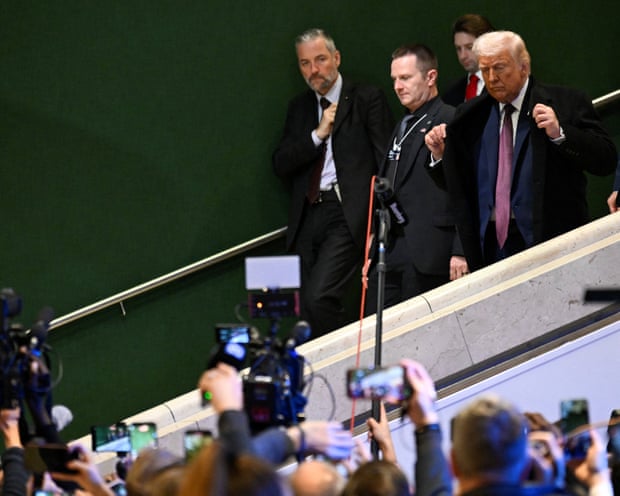
Donald Trump attends the 56th World Economic Forum in Davos, Switzerland. Photograph: Romina Amato/Reuters
Implications of Trump’s Statements
Trump’s Davos speech contains several key implications:
1. Damage Control — But Not Retreat — Ruling out force reduced immediate alarm among NATO allies and helped stabilize diplomatic relations, at least temporarily. It also prevented a rupture that might have led to punitive European measures (like tariff retaliation or strategic distancing).
2. Strategic Negotiation — By framing Greenland as a security priority yet backing away from force, Trump is signaling a negotiation strategy grounded in pressure — economic leverage, alliance bargaining, and vocal primacy rather than direct military action.
3. Alliance Trust and NATO Dynamics — Even though Trump walked back threats, the mere suggestion that force was an option has lingering effects. European leaders reaffirmed support for Danish sovereignty but also raised questions about U.S. reliability and strategic intentions — a tension that could influence future NATO cooperation.
4. Perceptions Abroad — International actors such as Russia seized on the earlier rhetoric to criticize the U.S. approach as a sign of crisis within the Western alliance. Moscow’s commentary underscores how Greenland has become a symbol of broader power competition.
Is War on the Table?
Despite the provocative rhetoric early in the period, most credible reporting indicates that military conflict over Greenland is not imminent. Trump’s public promises in Davos — backed by allies’ pushback — reflect diplomatic maneuvering rather than preparations for direct invasion. European and Danish resistance, combined with NATO’s structural commitments to collective defense and sovereignty, make a violent seizure highly implausible.
Still, Trump’s earlier comments and the continuing pressure serve as a reminder that even discussions about territory can test international norms — especially when voiced by a leader unafraid to leverage bold language.
A New Chapter for the Arctic
Greenland’s geopolitical relevance is no longer theoretical. New diplomatic frameworks, rising strategic competition, and the evolution of Arctic security conversations suggest that Greenland may soon be part of broader negotiations about military planning, climate change impact, and alliance dynamics.
Rather than war, what’s emerging is a high-stakes negotiation in which the United States seeks primacy — and Europe, Denmark, and NATO seek to balance cooperation with the defense of sovereignty and international law.
Only time will tell whether Greenland becomes a cornerstone of a new era of cooperation or a lingering point of contention in a fracturing global order.